“How much does an ecommerce website cost?” is a perfectly reasonable question, but it does not have one honest answer without context. A store with fifty products and one payment method is a different project from a B2B platform connected to an ERP, several warehouses and customer-specific price lists. Both may run on the same platform.
The technology sets the starting point. Scope, UX, integrations, data migration, testing and post-launch responsibility usually make the greater difference. The ranges below are useful for an initial plan, not for choosing a supplier from the lowest number alone.
Important: the net figures below are indicative planning ranges for a professional implementation. They are neither a price list nor a quotation. A simple store may cost less, while a complex ecommerce programme can cost considerably more.
Indicative ecommerce development budgets
| Platform | Indicative net budget | Typical context |
|---|---|---|
| WooCommerce | £1,400–£3,600 | Small or mid-sized store with simpler processes and integrations |
| PrestaShop | £4,000–£8,600 | Mid-sized ecommerce operation, larger catalogue and more modules |
| Shopify | £3,400–£9,400 plus subscriptions | Fast SaaS launch, predictable infrastructure and platform constraints |
| Magento 2 | £8,400–£20,700 and above | Complex B2C or B2B, integrations, automation and scale |
Working methods affect those budgets too. AI tools now accelerate code analysis, repeatable implementation work, tests and documentation. For engineering tasks that suit this kind of assistance, I need at least 50–60% fewer development hours than before. That does not make every project 50% shorter: workshops, business decisions, architecture, code review and accountable testing still need human attention. The direction is consistent with GitHub research into developer productivity.
The biggest saving appears when requirements are clear and the project already has good standards. AI can help produce code quickly, but it cannot decide how a discount should be reconciled in the ERP or which system owns product data. The less certain the process, the smaller the part of the budget that can sensibly be accelerated.
What really affects ecommerce development cost?
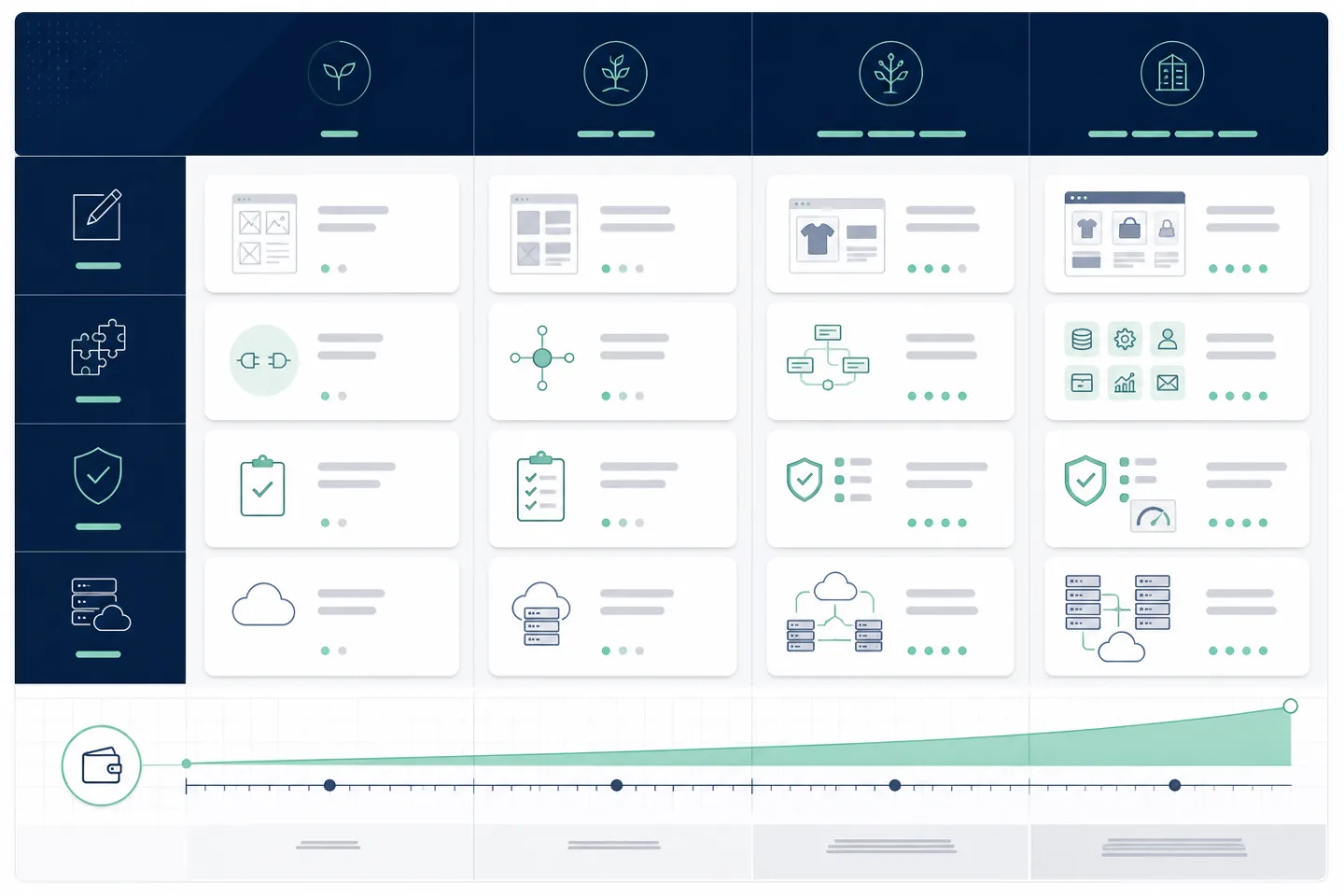
The largest differences usually appear in six areas:
- UX and UI: an off-the-shelf theme, adaptation of a component system or a bespoke design.
- Features: pricing rules, configurators, B2B, marketplaces, languages and currencies.
- Integrations: ERP, PIM, WMS, CRM, payments, couriers and finance systems.
- Data: migration of products, customers, orders, addresses and discount history.
- Quality: automated tests, performance testing, security and user acceptance testing.
- Launch: SEO redirects, final synchronisation, monitoring and stabilisation.
Integrations and data are the two areas I see underestimated most often. An API specification shows which endpoints exist; it rarely settles event order, bad records, duplicates, retries or operational ownership. Exceptions, not the happy path, tend to consume the time.
How do the platforms differ?
WooCommerce
WooCommerce suits a store closely connected to a content-led website with a relatively simple sales process. I like it for its quick start and broad ecosystem. The same ecosystem becomes a problem when a dozen plugins from different suppliers all influence checkout and every update needs a rescue plan.
PrestaShop
PrestaShop provides more commerce functionality out of the box than a typical WooCommerce setup. It is a sensible mid-market choice when key modules are audited before delivery. A cheap extension with no active maintenance can become expensive surprisingly quickly.
Shopify
Shopify transfers much of the infrastructure and maintenance responsibility to a SaaS provider. This shortens the route to launch and simplifies day-to-day operations. In return, you work within the platform, and subscriptions, apps, transaction charges and checkout constraints belong in the total cost of ownership.
Magento 2
Magento 2 makes sense when an ecommerce operation needs sophisticated B2C or B2B processes, many integrations, a complex catalogue and a long development horizon. Magento Open Source offers considerable freedom, but that freedom only creates value with sound architecture. If the business does not need it, a simpler platform may be the better decision.
How should project stages be priced?
Compare proposals stage by stage: discovery, UX and UI, development, integrations, data migration, testing, launch and stabilisation. If a proposal omits a stage, it is not necessarily cheaper; it may simply defer the cost or leave the responsibility with your team.
APK Studio starts by mapping processes, dependencies and risk. This separates launch requirements from the development backlog and supports sensible phasing. See how our delivery process works.
A useful estimate also exposes assumptions. If an integration has an existing API, record who owns its availability and data quality. If the client provides designs, agree whether they include mobile, error states and administrative components. One clear assumption can prevent weeks of debate.
Launch budget or total cost of ownership?
The launch estimate is only part of the bill. Hosting, licences, security updates, monitoring, integration changes and campaign support continue after go-live. SaaS platforms put more of that cost into subscriptions. With open-source software, more depends on code quality and the discipline of maintenance.
I therefore look at the next three years, not only launch day. Automated tests or a consistent component system may cost more now and make every later release cheaper. A feature used by a handful of customers may be better left for phase two.
When is a proposal suspiciously cheap?
A low price does not automatically mean poor quality. Reusable components, a small scope and a sharp process genuinely reduce cost. The warning sign is a proposal that promises everything while saying nothing about responsibility.
- Data migration, testing or launch support is missing.
- Integrations are one-line items with no failure handling.
- Licences and recurring costs are absent.
- The estimate assumes finished designs that nobody has reviewed.
- All uncertainty is deferred to later change requests.
How can you protect the budget?
- Write acceptance criteria for business-critical features.
- Separate the launch scope from the post-launch backlog.
- Require explicit assumptions and exclusions.
- Budget for licences, hosting, monitoring and at least one year of maintenance.
- Keep a contingency for data and integration discoveries.
The cheapest platform does not always produce the lowest total cost of ownership. First choose a solution that fits the company’s processes, team and pace of growth. Then reduce scope deliberately, without quietly removing the quality work that never appears on a mock-up.