


Aksotronik is an electronic components wholesaler selling exclusively to businesses. In this model, the online store is much more than a catalogue with an add-to-basket button. It has to support company accounts, controlled access to pricing, minimum order quantities, stock levels, incoming deliveries and data exchanged with back-office systems.
I have looked after Aksotronik’s Magento 1 store since December 2024. I develop the wholesale sales journey, remove practical limitations of the legacy platform and look after areas that are critical to current orders.
- Client
- Aksotronik, B2B electronics wholesaler
- Scope
- Magento 1 support and development
- Result
- Clearer buying processes and less manual administration

A sales model in which data is part of the offer
Aksotronik has operated in the electronics sector for many years and directly imports components. The store holds an extensive catalogue, while prices and purchasing are available after a representative of an active business signs in. A buyer can see actual stock, information about incoming deliveries and rules for wholesale quantities.
That distinction matters. In conventional B2C, hiding a price or adding an approval stage would normally add friction. In B2B, controlled access can be part of the commercial model. The platform still needs to make the process predictable and as short as possible for both the buyer and the sales team.
Developing a live Magento 1 store without freezing the business
A live store cannot be left untouched simply because it uses older technology. Orders continue to arrive, customers still need to find products and the sales team depends on reliable information. I therefore plan the work around specific operational needs without disrupting ongoing sales.
Work has been delivered in short, reviewable stages. Items affecting checkout, data synchronisation and security took priority: search by product codes, payment and delivery handling, order statuses, availability, pricing rules and forms. This keeps the legacy platform useful as a sales tool and responsive to the company’s current needs.
The guiding principle for legacy support: invest in work that reduces risk or materially improves selling, rather than funding expensive rebuilds without a clear commercial outcome.
A business account without retyping company details
Registration serves a different purpose in a wholesale store. It opens access to commercial terms, so the business needs to provide valid details and pass verification. Manually checking every application takes time, while mistakes in a company name, address or tax number later reappear in documents and integrations.
The process was extended to retrieve company information from public registers and check core business details. The customer enters the key company identifier and the form helps complete a consistent record. Access to pricing remains governed by Aksotronik’s commercial rules, but less administration needs to be completed by hand.
For a B2B owner, this is more than a form enhancement. Better customer data reduces exceptions in invoicing, order exports and subsequent account service.
Pricing, quantity breaks and negotiation that reflect wholesale trading
A B2B price can depend on the number of units, the case quantity, the customer relationship or a current promotion. Consistent quantity breaks and minimum order quantities were therefore important at Aksotronik. I corrected cases where values shown in the catalogue, product page and basket could otherwise lead to different interpretations.
I also added an option for signed-in customers to request an individual price once the relevant commercial conditions are met. Instead of opening a generic contact form, the customer starts the conversation in the context of a specific product and quantity. The sales team receives a better brief, while the buyer does not need to copy product references or explain which item the query concerns.
Promotional pricing needed separate control. The mechanism was adjusted so that a promotion does not imply availability after stock has run out and commercial teams can deliberately schedule when promotional terms become visible.
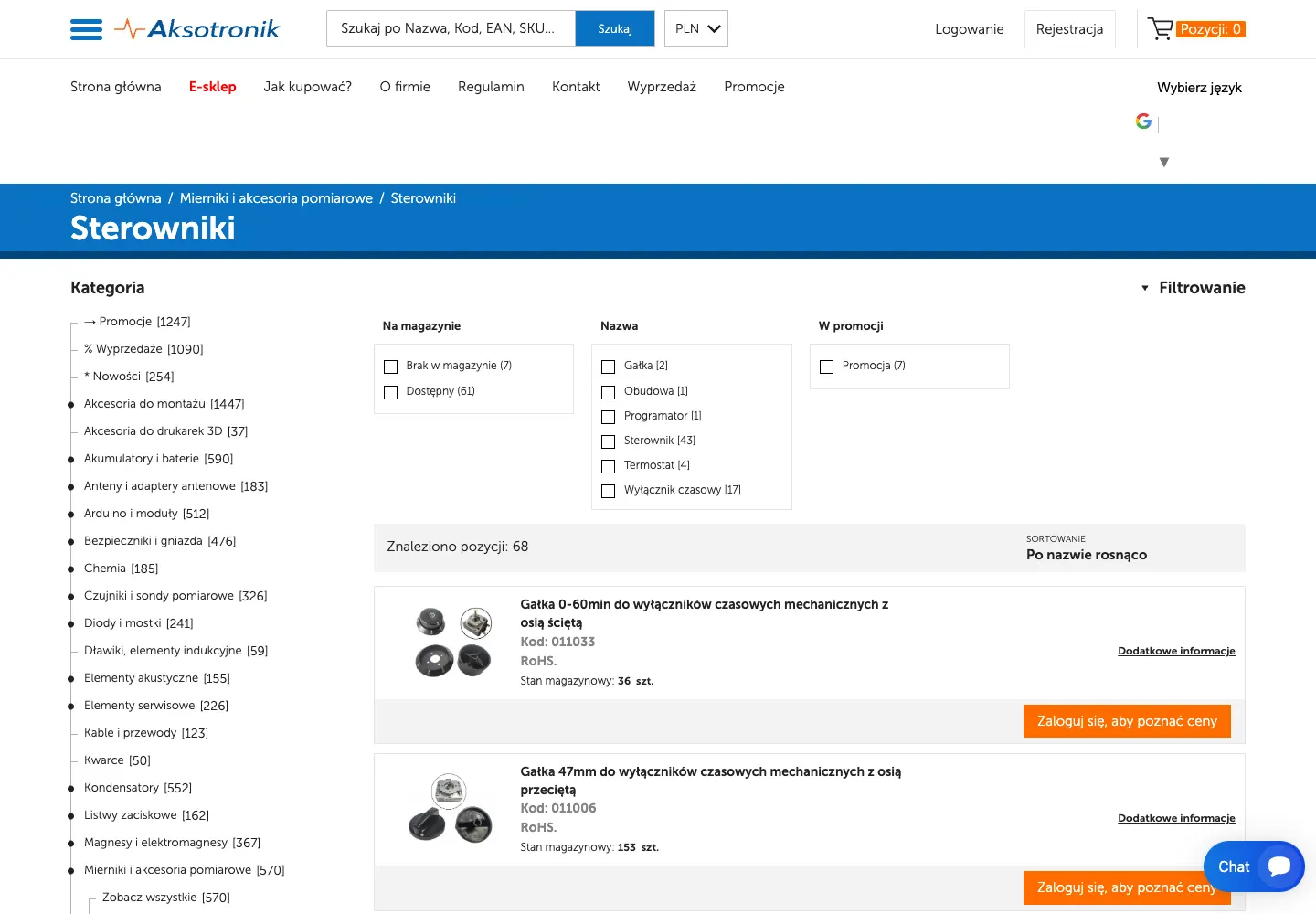
Actual stock, incoming deliveries and informed ordering
For a company buying components, “out of stock” is rarely enough information. The buyer wants to know whether a product is expected in the next delivery and whether the required quantity can be secured in advance. The wholesaler, meanwhile, must avoid promising a date or quantity that conflicts with operational data.
I clarified the presentation of zero stock and incoming deliveries. Where a quantity cannot be dispatched immediately, the buyer receives an explicit message and can consciously confirm an order for stock that is still expected. Promotional rules react when stock is exhausted, while availability remains linked to the back-office data flow.
Payment, courier delivery, scheduled tasks and notifications were improved alongside this work. These areas rarely make a dramatic screenshot, but they decide whether an order can travel from basket to fulfilment without someone manually rescuing the process.

Catalogue, search and the security of everyday operations
An electronic components buyer will often search by a symbol, reference or manufacturer rather than a marketing product name. Search was improved so that relevant product identifiers lead to the correct items. I also organised selected catalogue data, new-product labels and the presentation of supporting materials and images.
Security is the second pillar. A legacy Magento version requires particular discipline, so I introduced stronger protection for forms against automated submissions and restrictions around sensitive account-data changes. These controls do not remove the limitations of Magento 1, but they reduce operational exposure in day-to-day work.
Results and lessons for B2B ecommerce owners
The main result so far is a clearer set of touchpoints between the platform and real wholesale trading: company registration, availability, quantity pricing, negotiation, code-based search and order flow. The improvements reduce manual steps and ambiguity for both buyers and the sales team.
- Do not postpone necessary work simply because the store is older. Critical journeys still need to remain stable, secure and convenient for customers.
- Start with commercial rules, not visual design. Business accounts, quantity pricing, minimum quantities, availability and negotiation should be mapped before interface design begins.
- Treat ERP and data quality as part of the store. A B2B catalogue does not end in Magento; its credibility depends on information moving correctly through the company’s back office.
- Deliver larger changes in stages. Separate checks for data, integrations and buying journeys reduce the risk of errors accumulating.
Work is now also under way on migrating Aksotronik to Magento 2. This is a separate stage in the platform’s development. If you run a wholesaler on an older system and are considering a similar change, see how I approach a Magento 1 to Magento 2 store migration.